Keywords: Sap Flow, Evapotranspiration
Current Students Working on this Project:
Steve Lawton – Graduate Student in Civil and Environmental Engineering
Vivian Wanjing – Undergraduate Student in Environmental Engineering
Research Topics:
- Sap Flow
- Evapotranspiration
- Agrivoltaics
Research Description:
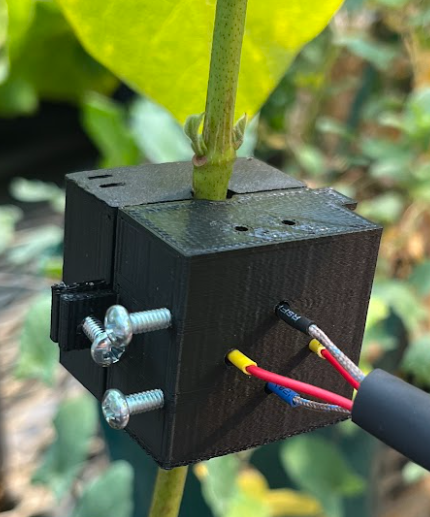
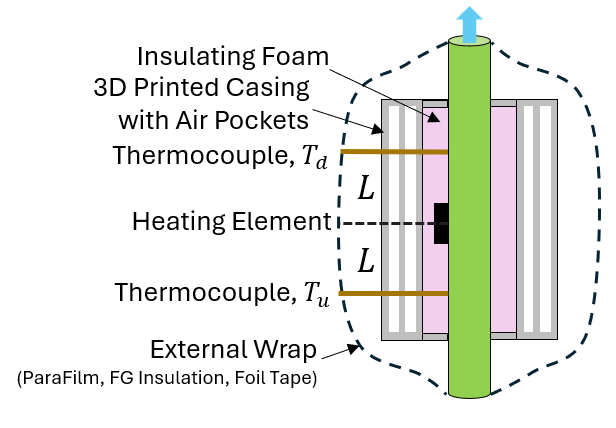
Evapotranspiration (ET), the combined transfer of water from soil to the atmosphere through evaporation and transpiration (plant water use), is a central term in the land-surface water balance. Accurate spatial ET estimates are therefore foundational for interpreting soil-moisture conditions, groundwater recharge, and vegetation productivity, and for evaluating how land management decisions alter water use at field and landscape scales. This project centers the development and evaluation of a low-cost, miniature sap flux sensor to measure distributed sap flux rates from narrow-stem, herbaceous plants, which can be upscaled to estimate whole-plant transpiration and areal ET rates. This sensor’s importance is highlighted in the context of agrivoltaic systems—integrating agricultural practices within photovoltaic (PV) panel arrays to maximize food, energy, and water benefits—which are gaining popularity in the Upper Midwest. In agrivoltaic fields, PV panels create heterogeneity in microclimate and soil moisture available to plants, which can ultimately impact plant water use. We aim to quantify the spatial variation in plant water use with a sap flux approach.
Common sap flux techniques estimate plant water use over time by tracing heat pulses through a plant stem. In this project, we are developing and evaluating a low-cost, miniature sap flux sensor—including design specifications, firmware, and post-processing programs—suitable for small-diameter herbaceous species commonly found in solar array seed mixes. The intended outcome is a field-ready, low-cost sensing approach to resolve solar array ET variation over the range of shading, airflow, and soil moisture conditions created by PV panels.